The PLC project
A complete project in your platform: hardware configuration, structured program in your standard, mode and sequence handling, interlocks, recipe, variant and parameter management.

Automation engineering for machine builders, system integrators and manufacturers
A complete machine program, written from the specification and tested against a simulation, delivered before the hardware is ready. It can be supplied on its own, or as the first phase of a project that we also commission.
The quality of an offline package depends largely on its inputs. The more of the following is available at the start, the more precise the quotation and the fewer the open questions during the work.
A complete project in your platform: hardware configuration, structured program in your standard, mode and sequence handling, interlocks, recipe, variant and parameter management.
F-CPU safety program with Profisafe devices configured — or Pilz and SICK safety where the concept calls for it — implemented against your safety concept and documented for acceptance.
WinCC Comfort, Advanced or Unified, Proface or Zenon: operation, manual mode, diagnostics, operator guidance and an alarm list with plain-language texts in the languages the plant needs.
Where the cell includes robots: motion programs, tool and base calibration data, safe interfaces to the PLC, and the signal list documented on both sides.
In the validated package: the PLCSIM Advanced and simulation model used for testing, so your team can reproduce every test we ran.
Program description, signal and alarm lists, sequence charts, and a handover note that tells your commissioning engineer where everything is.
We review the inputs and return a written scope, a price, a delivery date and a list of anything that appears to be missing or inconsistent. A good deal of the risk in a package is identified at this stage.
Program architecture, block structure and naming are agreed with the client's lead engineer before the bulk of the code is written. Where a house standard exists, it is adopted as part of the package.
The program is written against the agreed structure, with regular checkpoints so that progress is visible throughout.
The program runs against a simulated machine. Sequences, mode changes, variant switching, interlocks, alarm handling and fault recovery are exercised — including the failure cases that are awkward to provoke on real hardware.
You receive the project, the documentation and a test record showing what was proven and what could not be tested without hardware. The second list matters as much as the first.
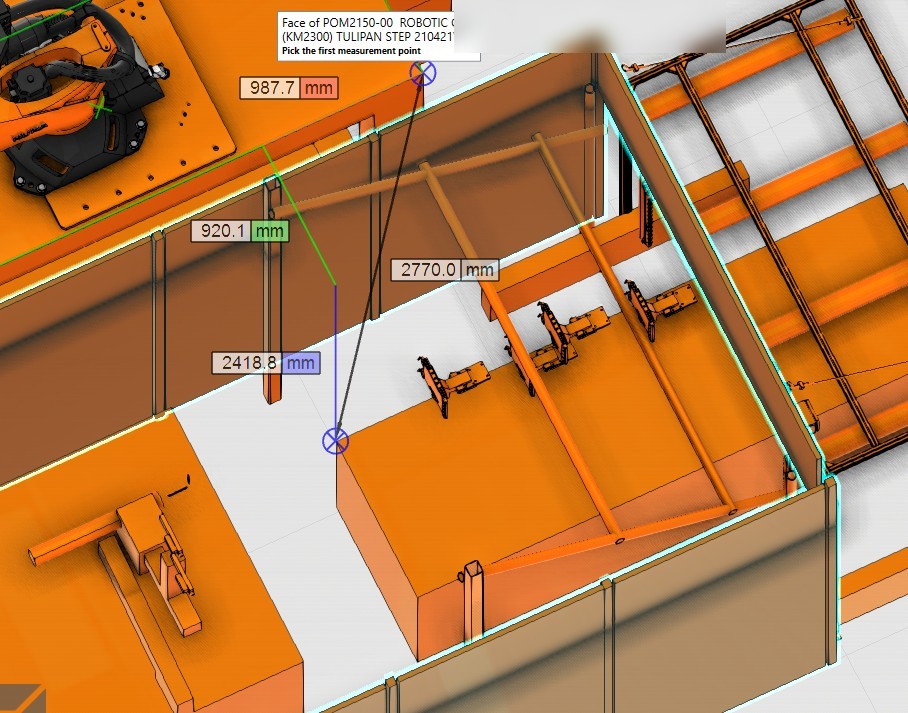
A simulation is a model, and a model is not a machine. Sensor alignment, mechanical tolerance, drive tuning, real cycle times, EMC behaviour and everything else that only exists in steel still have to be commissioned on site. An honest offline package removes the software risk from commissioning; it does not remove commissioning.
Each package therefore states what was validated and what was not, and the engineer who wrote the program remains available while the team is on site. More than ten years of commissioning experience informs that approach.
Packages are normally quoted at a fixed price against an agreed scope. Time and materials is available where the scope cannot reasonably be fixed in advance, for example on exploratory retrofits.
Typical lead time to start is one to two weeks. For a cell of moderate complexity, expect the offline phase to take three to six weeks from agreed specification to validated handover.